
He Onyi Odunukwe Built a $100M+ Empire Starting With a Tanning Salon (26 Businesses Later) | A COSIGN Interview
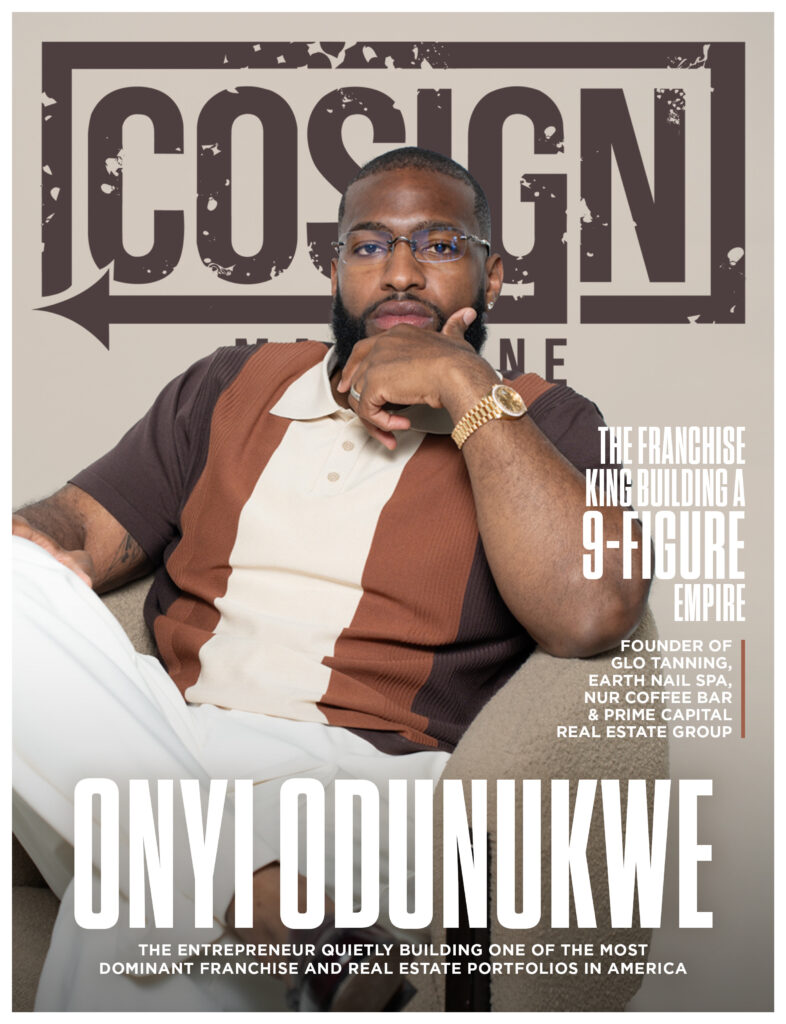
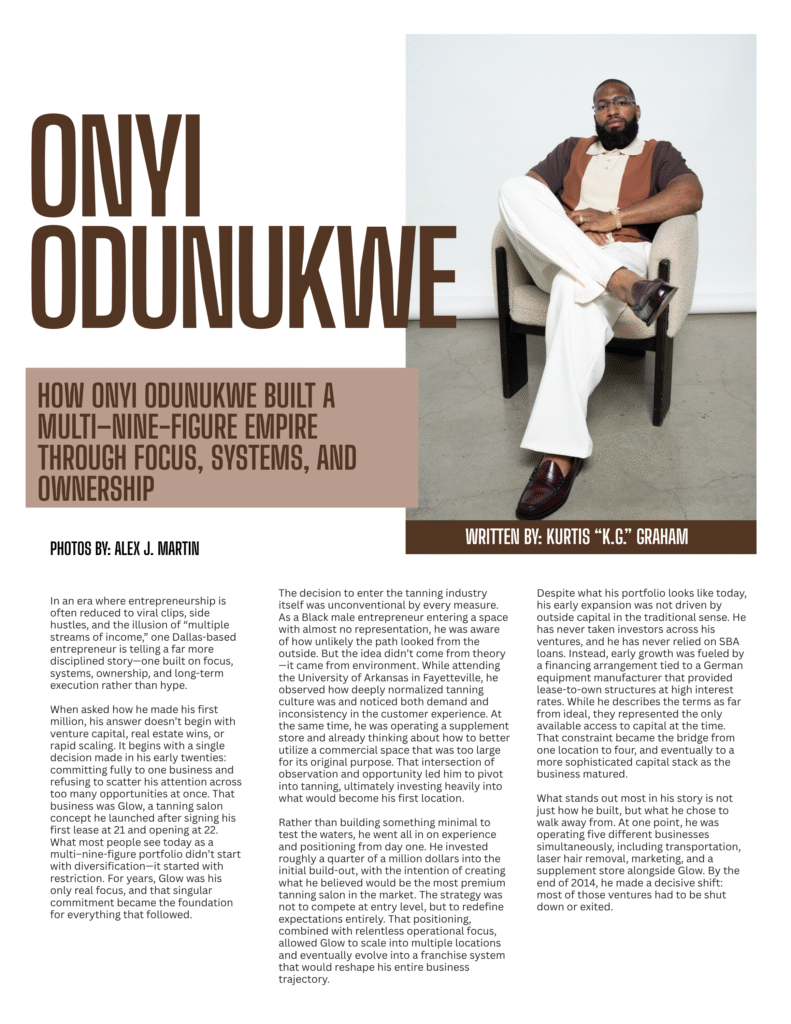
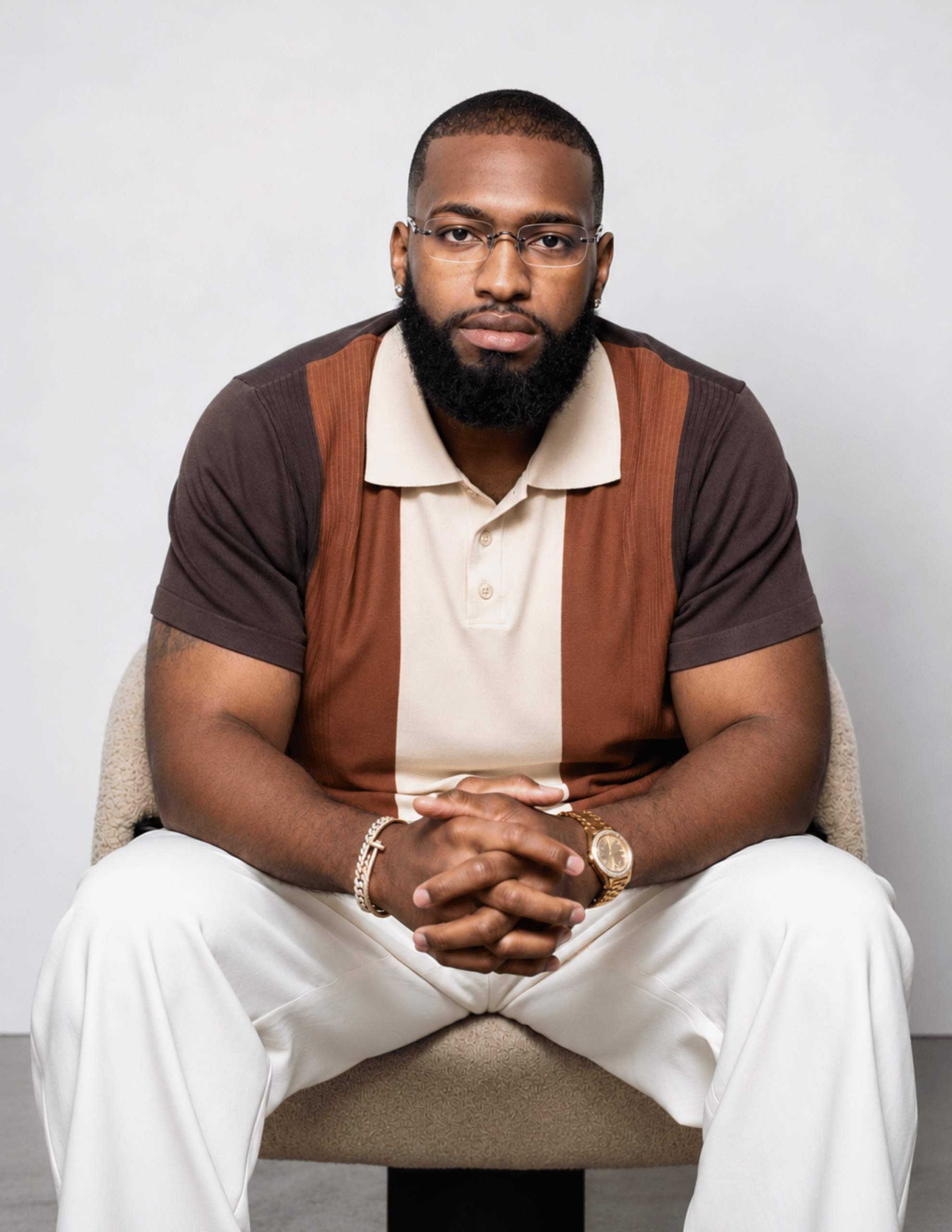
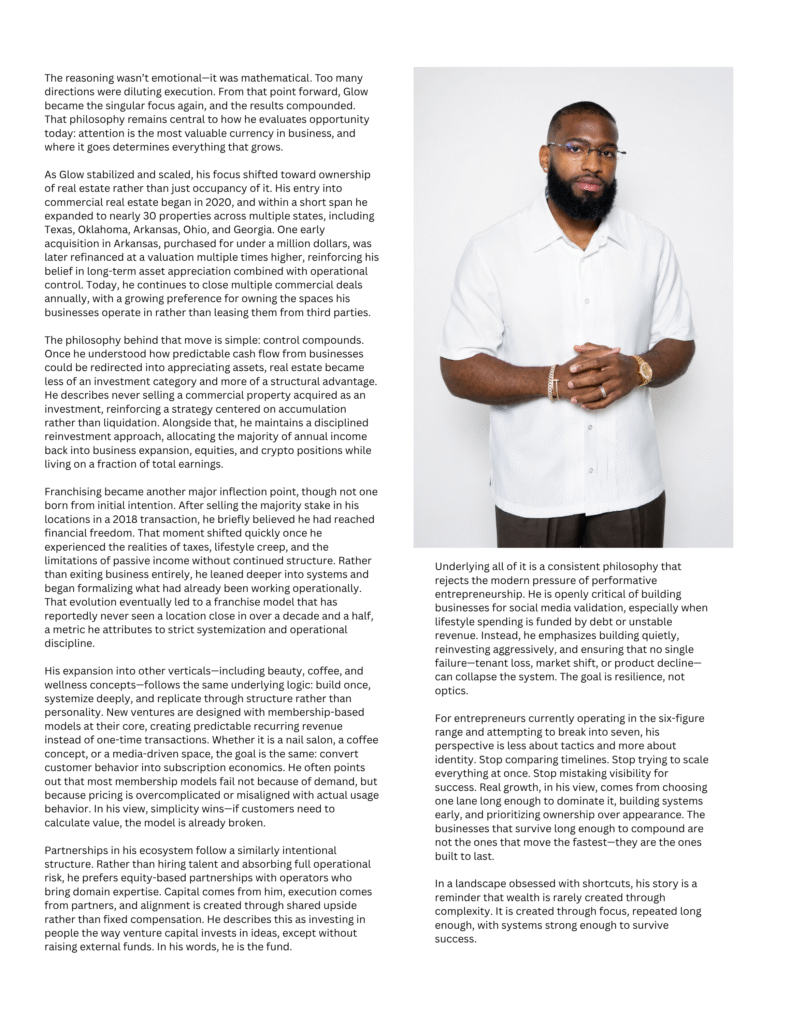
In an era where entrepreneurship is often reduced to viral clips, side hustles, and the illusion of “multiple streams of income,” one Dallas-based entrepreneur is telling a far more disciplined story—one built on focus, systems, ownership, and long-term execution rather than hype.
When asked how he made his first million, his answer doesn’t begin with venture capital, real estate wins, or rapid scaling. It begins with a single decision made in his early twenties: committing fully to one business and refusing to scatter his attention across too many opportunities at once. That business was Glow, a tanning salon concept he launched after signing his first lease at 21 and opening at 22. What most people see today as a multi–nine-figure portfolio didn’t start with diversification—it started with restriction. For years, Glow was his only real focus, and that singular commitment became the foundation for everything that followed.
The decision to enter the tanning industry itself was unconventional by every measure. As a Black male entrepreneur entering a space with almost no representation, he was aware of how unlikely the path looked from the outside. But the idea didn’t come from theory—it came from environment. While attending the University of Arkansas in Fayetteville, he observed how deeply normalized tanning culture was and noticed both demand and inconsistency in the customer experience. At the same time, he was operating a supplement store and already thinking about how to better utilize a commercial space that was too large for its original purpose. That intersection of observation and opportunity led him to pivot into tanning, ultimately investing heavily into what would become his first location.
Rather than building something minimal to test the waters, he went all in on experience and positioning from day one. He invested roughly a quarter of a million dollars into the initial build-out, with the intention of creating what he believed would be the most premium tanning salon in the market. The strategy was not to compete at entry level, but to redefine expectations entirely. That positioning, combined with relentless operational focus, allowed Glow to scale into multiple locations and eventually evolve into a franchise system that would reshape his entire business trajectory.
Despite what his portfolio looks like today, his early expansion was not driven by outside capital in the traditional sense. He has never taken investors across his ventures, and he has never relied on SBA loans. Instead, early growth was fueled by a financing arrangement tied to a German equipment manufacturer that provided lease-to-own structures at high interest rates. While he describes the terms as far from ideal, they represented the only available access to capital at the time. That constraint became the bridge from one location to four, and eventually to a more sophisticated capital stack as the business matured.
What stands out most in his story is not just how he built, but what he chose to walk away from. At one point, he was operating five different businesses simultaneously, including transportation, laser hair removal, marketing, and a supplement store alongside Glow. By the end of 2014, he made a decisive shift: most of those ventures had to be shut down or exited. The reasoning wasn’t emotional—it was mathematical. Too many directions were diluting execution. From that point forward, Glow became the singular focus again, and the results compounded. That philosophy remains central to how he evaluates opportunity today: attention is the most valuable currency in business, and where it goes determines everything that grows.
As Glow stabilized and scaled, his focus shifted toward ownership of real estate rather than just occupancy of it. His entry into commercial real estate began in 2020, and within a short span he expanded to nearly 30 properties across multiple states, including Texas, Oklahoma, Arkansas, Ohio, and Georgia. One early acquisition in Arkansas, purchased for under a million dollars, was later refinanced at a valuation multiple times higher, reinforcing his belief in long-term asset appreciation combined with operational control. Today, he continues to close multiple commercial deals annually, with a growing preference for owning the spaces his businesses operate in rather than leasing them from third parties.
The philosophy behind that move is simple: control compounds. Once he understood how predictable cash flow from businesses could be redirected into appreciating assets, real estate became less of an investment category and more of a structural advantage. He describes never selling a commercial property acquired as an investment, reinforcing a strategy centered on accumulation rather than liquidation. Alongside that, he maintains a disciplined reinvestment approach, allocating the majority of annual income back into business expansion, equities, and crypto positions while living on a fraction of total earnings.
Franchising became another major inflection point, though not one born from initial intention. After selling the majority stake in his locations in a 2018 transaction, he briefly believed he had reached financial freedom. That moment shifted quickly once he experienced the realities of taxes, lifestyle creep, and the limitations of passive income without continued structure. Rather than exiting business entirely, he leaned deeper into systems and began formalizing what had already been working operationally. That evolution eventually led to a franchise model that has reportedly never seen a location close in over a decade and a half, a metric he attributes to strict systemization and operational discipline.
His expansion into other verticals—including beauty, coffee, and wellness concepts—follows the same underlying logic: build once, systemize deeply, and replicate through structure rather than personality. New ventures are designed with membership-based models at their core, creating predictable recurring revenue instead of one-time transactions. Whether it is a beauty studio, a coffee concept, or a media-driven space, the goal is the same: convert customer behavior into subscription economics. He often points out that most membership models fail not because of demand, but because pricing is overcomplicated or misaligned with actual usage behavior. In his view, simplicity wins—if customers need to calculate value, the model is already broken.
Partnerships in his ecosystem follow a similarly intentional structure. Rather than hiring talent and absorbing full operational risk, he prefers equity-based partnerships with operators who bring domain expertise. Capital comes from him, execution comes from partners, and alignment is created through shared upside rather than fixed compensation. He describes this as investing in people the way venture capital invests in ideas, except without raising external funds. In his words, he is the fund.
Underlying all of it is a consistent philosophy that rejects the modern pressure of performative entrepreneurship. He is openly critical of building businesses for social media validation, especially when lifestyle spending is funded by debt or unstable revenue. Instead, he emphasizes building quietly, reinvesting aggressively, and ensuring that no single failure—tenant loss, market shift, or product decline—can collapse the system. The goal is resilience, not optics.
For entrepreneurs currently operating in the six-figure range and attempting to break into seven, his perspective is less about tactics and more about identity. Stop comparing timelines. Stop trying to scale everything at once. Stop mistaking visibility for success. Real growth, in his view, comes from choosing one lane long enough to dominate it, building systems early, and prioritizing ownership over appearance. The businesses that survive long enough to compound are not the ones that move the fastest—they are the ones built to last.
In a landscape obsessed with shortcuts, his story is a reminder that wealth is rarely created through complexity. It is created through focus, repeated long enough, with systems strong enough to survive success.
THIS ARTICLE IS POWERED BY: