
From Six Figures to Seven Figures: The Systems, Relationships & Discipline Behind Business Growth | 7 Figure Stories Powered by: Chase Bank (Part 1)
What does it really take to make your first seven figures and build a business capable of going beyond them?
Seven figures sounds like a finish line.
For entrepreneurs, it’s often just the beginning.
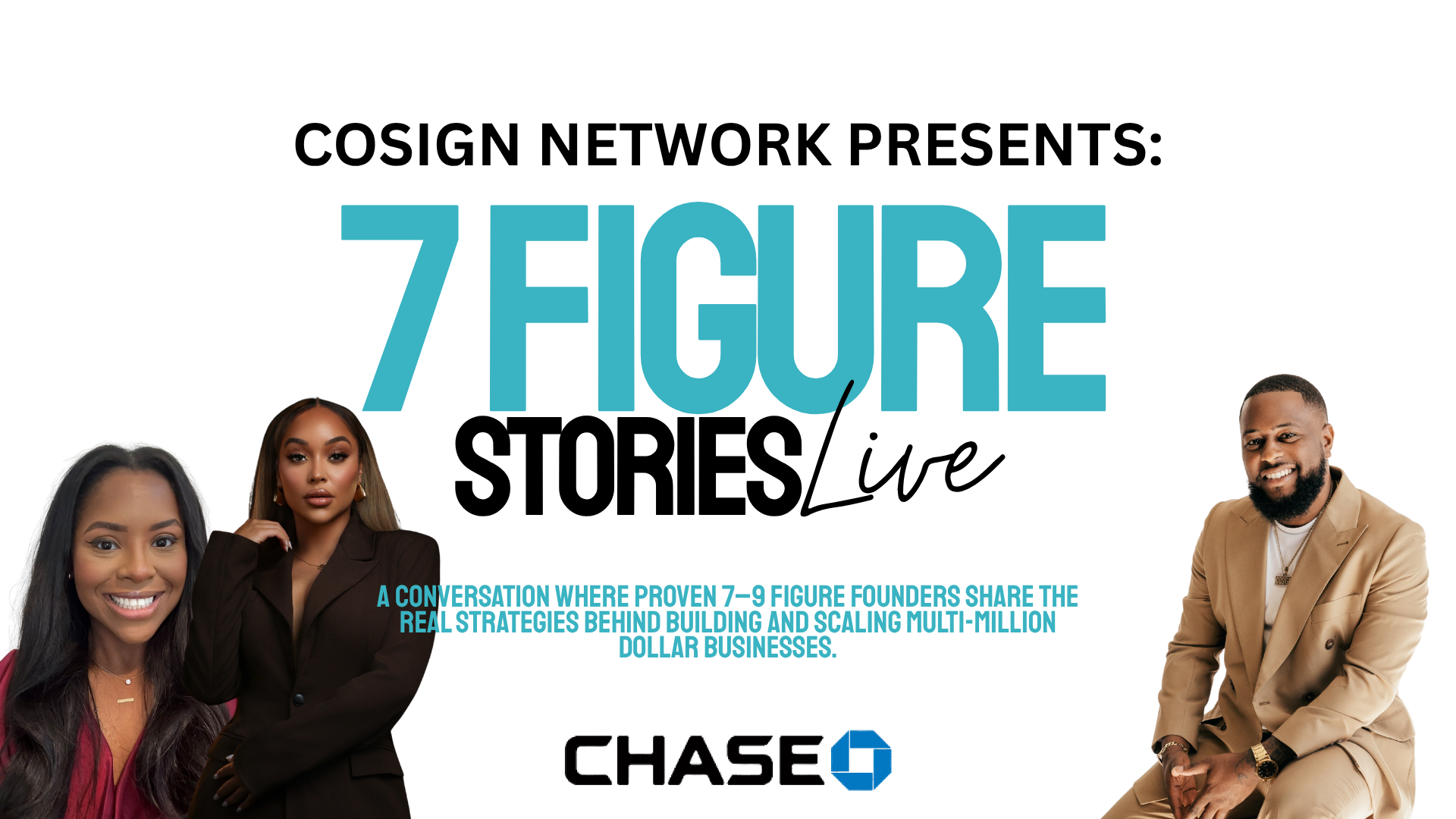
In a special edition of COSIGN Conversations, recorded at COSIGN Studios for the 7 Figure Stories, entrepreneurs and business leaders went behind the scenes of what it actually takes to move from six figures to seven—and eventually build toward eight or nine figures.
The conversation featured Keleisha Anderson, founder of The Vibe Brokerage, and Alicia Kemp, a business relationship manager at Chase Bank, alongside Kurtis “K.G.” Graham, Founder of COSIGN.
Their message was consistent throughout the conversation:
Seven-figure businesses aren’t built on hustle alone. They’re built on systems, financial discipline, relationships, education, consistency and the willingness to stop doing everything yourself.
Here are some of the biggest lessons from the conversation.

1. Hustle Can Get You Started. Systems Help You Scale.
Many entrepreneurs can hustle their way to their first $100,000.
But eventually, hustle becomes a bottleneck.
Keleisha Anderson experienced this firsthand when she launched her brokerage. She had already built a successful career as a top-producing real estate agent, but becoming a broker meant creating an entirely new operation.
There was no blueprint.
Instead of simply adopting the same systems everyone else was using, she found a developer who helped her build a customized back-office platform that combined functions including CRM, communications and payment processing.
The lesson isn’t that every entrepreneur needs custom software.
It’s that your business needs systems that allow the business to operate beyond your personal capacity.
Ask yourself:
Where are leads being captured?
How are prospects being followed up with?
How are payments processed?
How does your team communicate?
What happens when you’re unavailable?
Can someone else execute a task without asking you how to do it?
If the answer to most of those questions is “it’s all in my head,” you don’t have a scalable business yet.
You have a job that happens to have a business attached to it.
2. Become Bankable Before You Need the Bank
One of Alicia Kemp’s biggest lessons was simple: separate your personal and business finances.
For entrepreneurs who are used to transferring money whenever they need it, this can be an uncomfortable adjustment.
But if you want outside capital, lenders need to understand the financial story of your business.
That means knowing:
Your revenue
Your profit
Your expenses
Your accounts receivable
Your personal financial obligations
Your business financial obligations
It also means working with qualified financial professionals to make sure your books and tax filings accurately reflect the business.
As Kemp explained, financial institutions generally need to see enough documented profit and cash flow to determine whether a business can service debt.
In other words:
Making money and being bankable are not necessarily the same thing.
An entrepreneur can generate significant revenue while still making it difficult for a lender to understand the company’s financial position.
The goal is not simply to make more money.
The goal is to build a business that can prove it makes money.
3. Don’t Confuse Revenue With Wealth
One of the most important warnings from the conversation was about lifestyle inflation.
When revenue increases, it’s tempting to immediately increase spending.
New car.
New house.
Designer bags.
Bigger office.
More expensive lifestyle.
But seven figures in revenue doesn’t automatically mean seven figures in available cash.
Kemp discussed how overleveraging—both personally and through the business—can become a major barrier to growth.
Anderson shared a similar philosophy: before making major lifestyle purchases, she wanted to know that her business could sustain itself.
The principle is straightforward:
Don’t let your lifestyle grow faster than your business’s financial foundation.
Celebrate the wins, but build reserves first.
4. Build a Leadership Team Before You Think You “Need” One
At first, Anderson did everything.
She was the broker, operator and administrator.
Eventually, the workload became impossible to manage alone.
Her first hire was an administrative team member who could take responsibilities off her plate and allow her to focus on higher-value work.
That’s the evolution many entrepreneurs eventually face:
Founder → operator → leader.
Kemp pointed out that businesses approaching and exceeding the million-dollar mark typically need leadership beyond the founder.
That doesn’t necessarily mean immediately hiring a massive full-time executive team.
Fractional leaders and specialized professionals can help fill gaps in areas such as finance, marketing, people operations and strategy.
The key is understanding that delegation isn’t about getting rid of work. It’s about creating leverage.
If you spend all day doing $25-per-hour tasks, you don’t have time to perform the $1,000-per-hour work only you can do.
5. Know Your Numbers
Anderson doesn’t rely on a complicated daily dashboard to understand her brokerage.
Her leadership team meets regularly, and she tracks the numbers that tell her whether the business is moving in the right direction.
Among the metrics she watches:
Profit and loss
Agent count
Sales volume
Transactions
Year-over-year performance
Her benchmark is simple:
Are we doing better than we were doing this time last year?
That question can be applied to almost any business.
Entrepreneurs don’t need to obsess over every number every minute.
But they do need to know the numbers that determine whether the business is healthy.
You can’t improve what you aren’t measuring.
6. When Sales Slow Down, Go Back to the Fundamentals
Markets change.
Industries change.
Algorithms change.
Consumer behavior changes.
When Anderson’s real estate business encounters a slower period, her approach isn’t to panic.
It’s to pivot.
That can mean going back to the fundamentals:
Making calls
Revisiting the CRM
Following up with old prospects
Educating customers
Training the team
Adjusting the strategy to the current market
There’s an important distinction here:
You can’t always predict revenue, but you can influence productivity.
If your historical numbers show that a certain amount of outreach produces a certain number of conversations and sales, you have something you can control.
When things slow down, go back to the activities that created momentum in the first place.
7. Education Can Become Your Best Lead Magnet
One of Anderson’s biggest breakthroughs came from educating her community about homeownership.
Rather than simply telling people she was a real estate agent, she created educational experiences around a problem her audience cared about.
She hosted events that brought hundreds of people together to learn about homeownership, including ways people could potentially become homeowners without having tens of thousands of dollars sitting in the bank.
The result?
Education created trust.
Trust created relationships.
Relationships created customers.
And those customers continued to follow her brand.
This is an important lesson for entrepreneurs in every industry:
Teach people what you know.
If you’re a CPA, educate people about financial mistakes.
If you’re a marketing agency, teach business owners how to generate leads.
If you’re a contractor, explain the renovation process.
If you’re a financial professional, help people understand financial concepts.
Your expertise can become your marketing.
WATCH THE FULL "7 FIGURE STORIES" CONVERSATION BELOW:
Seven Figures Is Built Before the Number
The road to your first seven figures isn’t about finding one secret strategy. It’s about building the habits, systems and relationships that make growth sustainable.
As Keleisha Anderson and Alicia Kemp shared throughout this conversation, the businesses that scale aren’t necessarily the ones with the most resources at the beginning. They’re the ones willing to learn, adapt, build the right systems, know their numbers, invest in people and stay consistent when things get difficult.
And perhaps the biggest takeaway?
You don’t have to have everything figured out before you start building. But you do have to be willing to evolve as the business grows.
Going from six figures to seven isn’t simply about making more money. It’s about becoming a better operator, a better leader and a better steward of the business you’ve built.
But getting to seven figures is only one part of the story.
What happens after you hit the million-dollar mark?
How do you protect what you’ve built? How do you build a leadership team? How do you avoid the mistakes that can cost you everything? And what separates a $1 million business from a $10 million business?
In Part Two of the 7 Figure Stories, we continue the conversation with the lessons that can help entrepreneurs go beyond seven figures—and build something that lasts.
Until then, keep building, keep learning, and continue to live the COSIGN life.