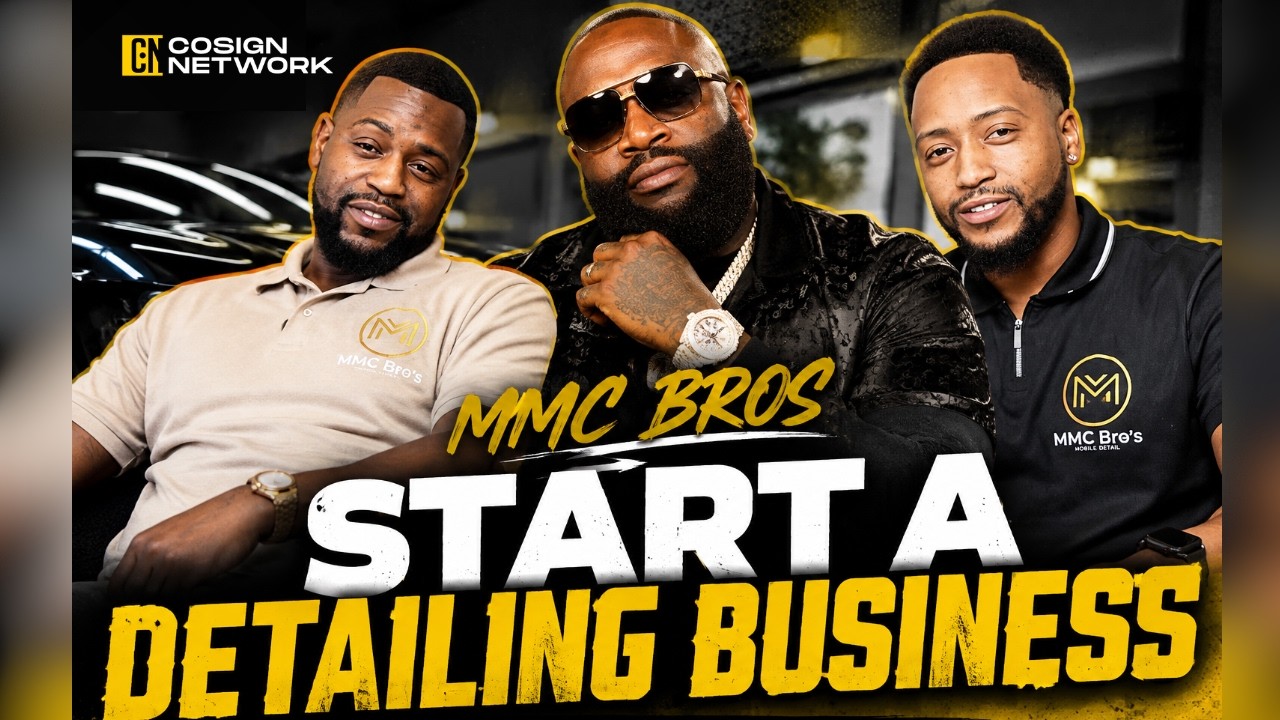

How MMC Bros Built a Mobile Detailing Business From the Ground Up — And Used Networking to Meet Rick Ross
What does it really take to start a mobile detailing business? According to Dallas entrepreneurs MMC Bros, it might be less than you think.
What started with a truck, a trailer, and skills learned from washing cars as kids has evolved into a full-time mobile detailing business that has taken two brothers outside of Dallas, into major automotive events, and even onto Rick Ross’ property.
In a recent episode of COSIGN Conversations, K.G. Graham sat down with MMC Bros to discuss the realities of building a detailing company—from pricing and profitability to networking, hiring, recurring revenue and scaling.
Their story also provides a blueprint for entrepreneurs trying to turn a skill into an actual business.
From Washing Cars to Building a Business
MMC Bros didn’t start with a massive investment, storefront or large team.
The brothers grew up washing cars and learning the basics from their father. Years later, a childhood friend whose father was involved in detailing helped introduce them to the business more seriously.
They had a truck. Their friend had a trailer.
They put the pieces together and started.
Since launching around 2020, the brothers have continued building the business, eventually operating two trucks while servicing clients through a completely mobile model.
But one of the biggest lessons they learned was that being good at detailing and being good at business are two completely different things.
“The hardest thing is just the ins and outs of the business,” they explained during the conversation.
Washing and detailing cars was the skill. Learning the numbers, client processes, hiring and back-office operations was the next level.
How Much Does It Cost to Start a Mobile Detailing Business?
One of the most important takeaways from the conversation is how accessible the detailing industry can be for someone willing to start small.
MMC Bros explained that they initially purchased more equipment than someone necessarily needs when first getting started.
You don’t need the perfect truck, massive water tank and every premium piece of equipment on day one.
For a young entrepreneur starting from home, they estimate that it may be possible to get started with roughly $500 in basic equipment, depending on the setup.
The bigger lesson?
Start with what you can afford. Get customers. Generate revenue. Then reinvest into better equipment.
You don’t need to look like a six-figure company before you’ve made your first dollar.
The $60 Pricing Lesson That Changed Their Business
MMC Bros also learned an important lesson that almost every new entrepreneur eventually encounters:
Revenue isn’t the same thing as profit.
When they first started in 2020, the brothers were charging around $60 for their service.
At the time, getting customers and generating revenue felt like progress.
Then one of their clients—a dentist and business owner—asked them a question that changed the way they looked at the company:
Were they actually making money?
The client encouraged them to examine what the business was truly costing them, including labor and other expenses. That conversation contributed to MMC Bros reevaluating their pricing.
It’s a lesson that applies far beyond detailing.
If you charge a customer $200, you didn’t necessarily make $200.
Entrepreneurs have to account for labor, equipment, products, transportation, taxes and operating expenses before determining what actually hits the bottom line.
As MMC Bros put it during the conversation:
Understand your P&L.
Why Recurring Revenue Changes the Business
Another evolution for MMC Bros has been moving beyond one-time customers.
The brothers have weekly clients and recurring arrangements while working toward expanding the membership side of the company.
That’s an important transition for any service entrepreneur.
Instead of waking up every month needing to find an entirely new group of customers, recurring clients create a predictable base of revenue.
For a detailing company, that can mean taking someone from an initial full detail into an ongoing maintenance plan.
The first transaction gets the customer.
The recurring relationship builds the company.
Networking Took Them Beyond Dallas
One of the biggest themes of the MMC Bros story isn’t actually cars.
It’s relationships.
The brothers have intentionally attended automotive events, traveled outside of Dallas and put themselves in environments where potential customers and partners already exist.
That strategy eventually took them to the Rick Ross Car & Bike Show.
What could have simply been a trip to a car show became a business opportunity.
They networked, met people and were in the same environment as Rick Ross and other notable entertainers and entrepreneurs. More importantly, they approached the event as an opportunity to build relationships that could turn into future business.
“We kind of look at the car show stuff as like this is bigger than a car show,” they explained.
The person you meet at an event today could become a customer months later.
“Networking Is a Waste of Time” — Unless You Know How to Use It
Entrepreneurs frequently debate whether networking events are actually worth attending.
MMC Bros have a different perspective.
Networking can be hit or miss, but they emphasized that you never know who may be in the room.
The key is actually speaking to people.
Tell people what you do.
Learn what they do.
Find where there might be an opportunity to work together.
K.G. added another important distinction during the conversation: networking should be strategic.
You don’t have to attend every event.
Instead, identify the rooms where your potential customers, partners or key relationships are likely to be and intentionally put yourself there.
Turn Business Travel Into Business
MMC Bros have taken that philosophy beyond Dallas.
When traveling to events or conferences, they try to find detailing work in the destination city.
The goal is simple: make the trip produce something.
Even if the business generated doesn’t cover every expense, they’re still building relationships, gaining experience and creating opportunities in another market.
The brothers shared that they’ve successfully made money in other states, with Atlanta becoming one of their strongest markets outside of Dallas.
That’s a powerful lesson for entrepreneurs who travel frequently:
Don’t only ask, “How much will this trip cost me?”
Ask:
“How can this trip create an opportunity?”
Stop Treating Every Entrepreneur Like Competition
Perhaps one of the strongest business lessons from the entire conversation came while discussing expansion and subcontracting.
When a company receives more work than it can physically handle, another business in the same industry doesn’t necessarily have to be a competitor.
They can become a partner.
A detailing company can subcontract another detailer.
A marketing agency can outsource production.
A contractor can bring another contractor onto a project.
One company can hold the client relationship while multiple businesses participate in delivering the work.
As K.G. explained during the conversation, entrepreneurs can’t look at everyone as competition.
MMC Bros agreed:
“Partnership is where it is.”
Sometimes owning a piece of a larger opportunity is more valuable than owning 100 percent of a small one.
Mobile First Means Lower Overhead
MMC Bros currently operates as a completely mobile business.
Instead of customers traveling to them, they bring the service directly to the customer.
That creates convenience for the client while allowing the company to operate without the expenses associated with maintaining a permanent location.
The brothers eventually want a brick-and-mortar location, but they’re conscious of what comes with it.
Rent. Employees. Inventory. Utilities. Additional overhead.
Their advice is essentially to make sure the numbers support expansion before adding expenses simply because having a physical location looks impressive.
That’s another lesson applicable to nearly every startup:
Don’t add overhead before the revenue can support it.
The Goal Is to Eventually Stop Doing Everything Yourself
Today, MMC Bros are still heavily involved in the day-to-day operation.
They’re detailing. They’re finding customers. They’re managing jobs. They’re building relationships. They’re working in the business while simultaneously trying to work on the business.
But the long-term goal is bigger.
They want to create enough consistent work to employ people, provide dependable opportunities for their team and eventually remove themselves from physically detailing every vehicle.
That’s the difference between creating a job for yourself and building a company.
At first, you are the system.
Eventually, you have to build the system.
The Bigger Lesson From MMC Bros
The MMC Bros story isn’t only about detailing cars.
It’s about what happens when entrepreneurs take an ordinary skill and begin treating it like a real business.
They started small.
They learned the craft.
They underpriced themselves.
They learned their numbers.
They built relationships.
They traveled.
They reinvested.
They created partnerships.
And now they’re working toward building a company that can eventually operate beyond the two founders.
For aspiring entrepreneurs, their story is another reminder that you don’t always need a revolutionary idea or massive startup capital.
Sometimes you need a skill people will pay for, enough equipment to get started, the willingness to talk to people and the discipline to learn the business behind the service.
The skill can get you your first customer.
The relationships, numbers and systems are what help you build the company.
Watch the full COSIGN Conversations featuring MMC Bros to hear their story, how they built their mobile detailing company, what they learned about pricing and profitability, how networking opened doors outside of Dallas, and their advice for anyone thinking about entering the detailing industry.
Who Do You #COSIGN?
COSIGN is dedicated to telling the stories of entrepreneurs, creatives and leaders shaping business and culture. Follow COSIGN for more conversations, business insights and entrepreneurial blueprints.