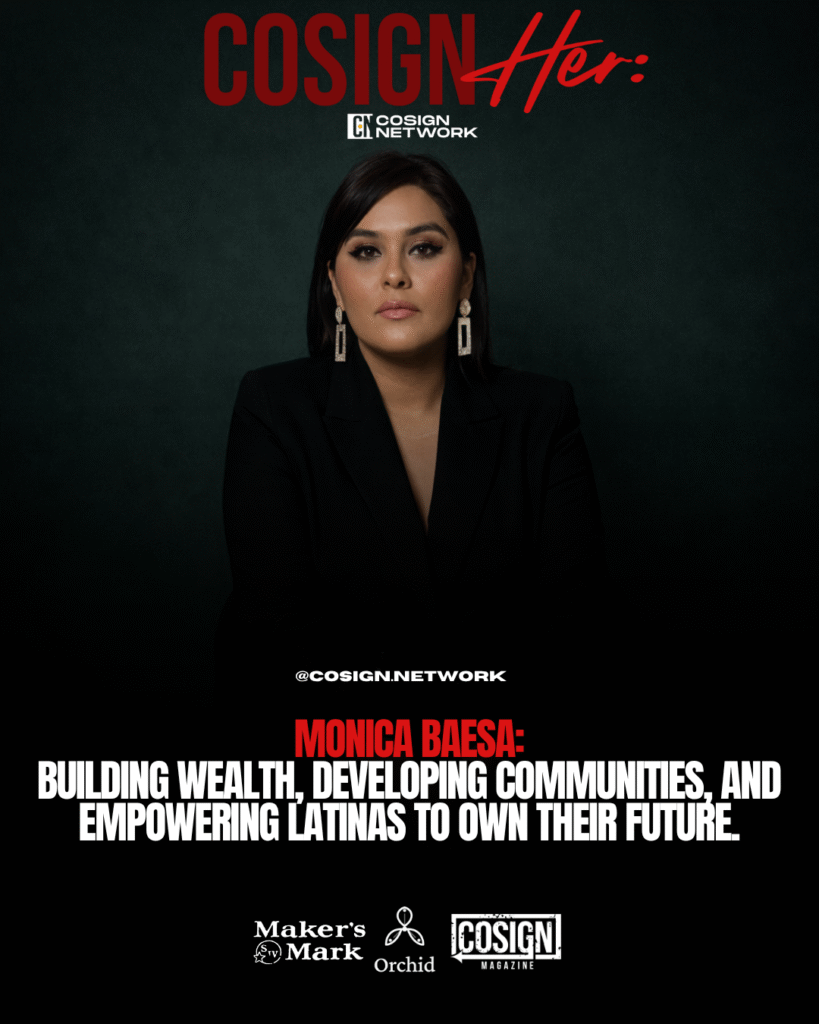

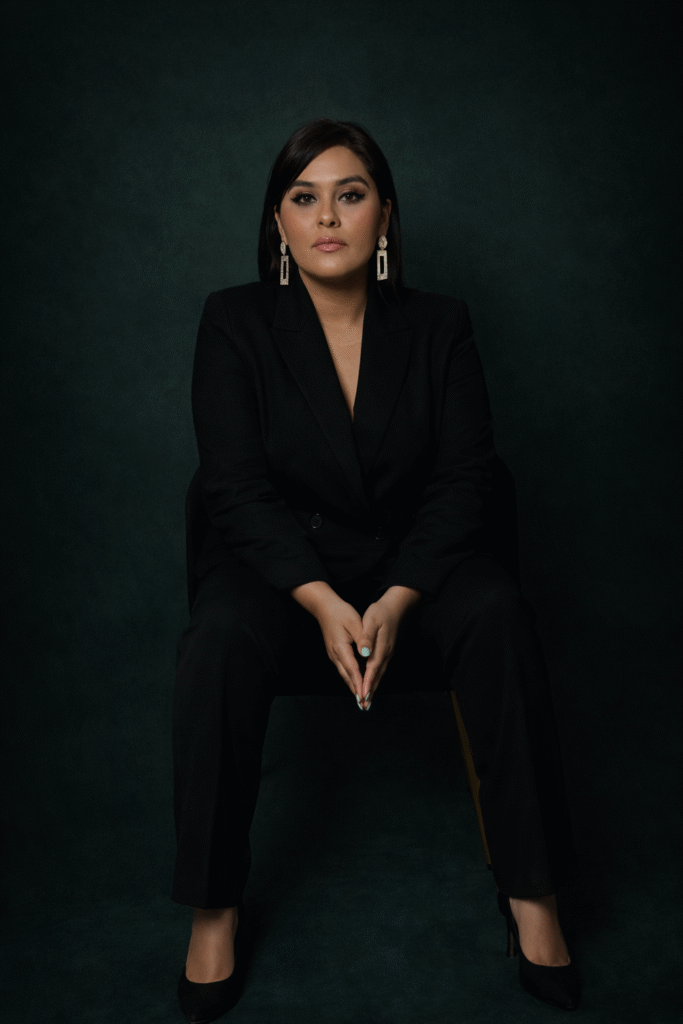
COSIGN Her: Monica Baesa Is Reimagining What Development Looks Like in Dallas–Fort Worth
In cities across America, the people shaping the skyline rarely look like the communities living beneath it. For Monica Baesa, that reality became both a challenge and a calling.
Today, Baesa is emerging as a powerful voice in real estate development across Dallas–Fort Worth—an industry where Black and Brown developers still make up less than three percent nationwide. As the founder of Living Bloom Casas™ and the visionary behind multiple housing initiatives focused on sustainability and workforce accessibility, she is helping redefine what development can look like when the people building communities come from them.
But Baesa’s journey into real estate didn’t start with blueprints or capital partners. It started with responsibility.
“My path into real estate wasn’t traditional,” Baesa says. “It started with needing to provide for my family.”
She entered the workforce through the multifamily housing industry and quickly found herself rising through the ranks. Eventually she became a regional manager overseeing multiple apartment communities across Dallas–Fort Worth. The job required her to manage large capital improvement projects, coordinate maintenance teams across properties, and oversee renovation budgets and construction timelines.
That role became her first real exposure to how value is created in real estate.
“I was leading apartment rehabs and coordinating construction projects across properties,” she explains. “That’s when I started to understand how renovations and repositioning could create real value in housing.”
But the demands of the job came at a cost. The relentless pace and pressure eventually led to burnout and serious mental health challenges—forcing Baesa to confront a difficult truth.
Something had to change.
She stepped away from the role and took a risk on herself, launching her own construction and remodeling business. The early days were far from glamorous. She took on small projects—often insurance-related repairs—while documenting the work on social media.
“I started posting the projects on Instagram and TikTok,” she says. “And eventually those posts started attracting attention.”
What began as a small remodeling business soon opened new doors. Investors started reaching out, and Baesa began working on fix-and-flip properties and affordable housing projects across the region.
But through that work, she had a realization that shifted her mindset entirely.
“I realized I was helping create value in underserved communities,” she says, “but often for someone else’s portfolio.”
That moment sparked a bigger vision. Instead of simply executing projects, Baesa began seeing herself as someone capable of owning and developing them.
What pushed her even further was discovering just how underrepresented people of color are within the development industry.
“When I learned that Black and Brown developers represent less than three percent of the industry nationally, it made something very clear,” she says. “Representation in development is still incredibly limited.”
Rather than seeing that statistic as discouraging, Baesa saw it as motivation.
Today, her work focuses on development, ownership, and designing housing that creates long-term stability for the communities she comes from.
Through her company Living Bloom Casas™, Baesa is pioneering a development approach centered around biophilic design—a concept that integrates nature, sustainability, and wellness into housing environments.
“Biophilic development is about reconnecting people with nature instead of separating them from it,” she explains.
For decades, many urban housing developments have prioritized density and efficiency above all else. Baesa believes the future of housing must consider something deeper: how people actually live and how their environments affect their well-being.
Her projects incorporate ideas like community gardens, edible landscaping, rainwater collection systems, and green design elements that bring nature into everyday living spaces. Inside homes, biophilic principles can include natural light, indoor greenery, and layouts designed to promote calm and connection.
“As cities grow, we can’t just think about where people live,” Baesa says. “We have to think about how those environments impact their health, sustainability, and quality of life.”
That philosophy extends beyond architecture. For Baesa, development is not just about buildings—it’s about people.
“I approach development differently because I come from the communities I’m building in,” she says. “A lot of development focuses on the building itself or the return on investment. I think about the people who are actually going to live there.”
That perspective has led her to focus heavily on workforce housing—homes designed to remain attainable for the teachers, nurses, service workers, and first responders who keep cities functioning.
In fast-growing regions like Dallas–Fort Worth, housing prices have surged faster than wages for many working families. As that gap widens, entire communities risk displacement.
“If cities want to remain strong and functional, we have to build housing the workforce can actually afford,” Baesa says. “It’s about making sure the people who contribute to the life of a city still have a place in it.”
Baesa’s work doesn’t stop at housing. She also founded the Latina Wealth Circle Foundation, a nonprofit dedicated to helping women—particularly Latina entrepreneurs—gain access to financial education, mentorship, and capital.
The idea came directly from her own experience navigating entrepreneurship.
“I saw firsthand how difficult it can be for women—especially Latina founders—to access capital and the networks needed to grow their businesses,” she says.
Through the foundation’s programs, women are equipped with tools to stabilize their businesses, understand financial systems, and position themselves to access larger funding opportunities.
“Many talented women are building businesses,” Baesa says. “But too often they’re underfunded and under-supported.”
For Baesa, the solution is building infrastructure that supports long-term success.
“When women have access to the right tools, knowledge, and capital, they don’t just build businesses,” she says. “They build assets, create jobs, and strengthen entire communities.”
That philosophy is captured in the mission that guides her work: Build assets. Build access. Build legacy.
For Baesa, legacy goes far beyond personal success.
“Legacy means creating something that outlives you and continues to impact others long after you’re gone,” she says.
That includes building stability and opportunity for her own family—but also for the communities she comes from and the next generation of entrepreneurs and developers who will follow.
“Ownership changes the trajectory of families,” she says. “And ownership changes communities.”
Baesa also believes one of the most powerful shifts people can make is simply changing how they think about wealth.
“The first step is shifting your mindset from thinking like a consumer to thinking like an owner,” she says.
Real estate, she explains, remains one of the most powerful tools for building long-term wealth and influence.
“Once you understand how land, housing, and development shape communities, you begin to see opportunity differently.”
As a Latina leader in an industry historically dominated by men, Baesa understands how powerful representation can be.
“When women see someone who looks like them building companies, developing housing, and owning assets, it expands what they believe is possible,” she says.
But she’s quick to point out that visibility alone isn’t the end goal.
“Representation matters,” Baesa says. “But the real goal is ownership.”
Her vision for the future is clear: more Latina women owning land, leading development projects, building companies, and shaping the cities where they live.
For Baesa, the mission is not simply to participate in the industry—it’s to transform it.
And in doing so, she’s proving that the future of development will look a lot more like the communities it serves.

This feature is part of the COSIGN Her series, in partnership with Maker’s Mark, honoring 17 women who are making their mark and leading the next era.
This article is also powered by Orchid — where women don’t compete, we compound. Join a private, intelligent network built for ambitious women to grow, connect, and build real momentum. Request your invite at https://www.orchidonline.co and use code #COSIGN2026.